Sunday, 26 May 2019

Inquiry Post: Week 5; Term 2

                           Wonderful Whacky Writing

Writing has been challenging this year in our shared space. Mrs Carruthers and I had to split the group into two to allow for the proper scaffolding to take place. We have had to be inventive and come up with exciting ideas to get our students interested in writing. 

It is not always feasible to plan an activity or experience for the students to do on a Monday morning that they can then go off and write a recount on. For many of our students who are not independent writers we had to devise a way they could become independent. Sound bites saved us. We decided to create EE's and dictate sentences. Along with the dictation they had to form the words in front of them to make a complete sentence. Once the sentence is correctly formed they write this up in their book. 

The next step we did for these students was to get them to do their own dictation. Record themselves saying one simple sentence they wanted to write. We encouraged them to use the yellow writing card words so they would have help with their spelling. 

This worked well with most of them. Of course there were the students who thought it would be funny to be silly and say inappropriate things. But once their i-pad was removed and they had to go back to using pencil and paper their attitude soon changed and the next time they were asked to dictate they did so willingly. 

Below is an example from a pick-a-path story the students are doing for Creative Space and their Hyperstudio animation. As you can see every child had the choice of what they played on at the playground and the teacher helped them insert this. 


Knowing our students love to watch movies on their i-pads we researched and found some great short videos without orations. The students were asked to watch the movie and write a dialogue to go with the movie. The top writers were able to independently go off with their headphones and step by step write their own story line. They were encouraged to pause the video many times and write what they had seen and then restart video. This way they did not miss out any important features. 


Once they were finished their story and it was on their blog they then got the opportunity to animate their story using their i-pad. I downloaded scenes from old junk yards and car wreckers and they could chose their own backdrops. Their job was to draw their characters and input them into the correct slides and tell their story. 


The students really enjoyed this activity. The students who needed more support were given a simple dictation of 4 slides. 

Mrs Carruthers and I swap the writing groups over every 2-3 weeks. This gives us both the opportunity to work with all students and all levels. One thing I have noticed working with such a diverse range of learners. You have to mix things up. You have to make the writing experience new, fun and most of all challenging. Everyone needs to be challenged as it makes you step up and become the best version of yourself. This is the same when writing. Scaffolding each group correctly is really important to draw the best out of our students. Kids love to experiment and try new words and phrases and giving them the opportunity to do so will surely have positive results. 


Sunday, 3 March 2019

2019 Inquiry Focus. Wonderful Whacky Writing


Inquiry Focus: 

Could I use the same DMIC prompts to help shift my target group to become independent writers. 

Step 1. Learning levels of children and what their next steps are.

Step 2. Create target group

Step 3. Scaffolds

Step 4. Hypothesis strategy that I will use.

Step 5. Interesting writing activities for students to do when they are not with me.

Step 6. Teach students what to do when they get stuck so they are not roaming the classroom. 

After 11 years of teaching the one subject that always brings about the most groans is Writing. Kids just seem to hate writing. 

I believe for many kids who I teach they are not having enough personal experiences to write about. As the old saying goes, when your stuck write about something you know, have experienced, or a place you have travelled to. When these experiences don't happen and you stay home every weekend, its super hard to get revved up when the teacher says, "Lets all write a recount on our weekend" 

So every Monday morning I will be giving my students an experience to write about. 

Last week we went to the playground and just had some fun climbing the ladder, swinging on the ropes and playing on the monkey bars. 

We came back to class and had a great discussion about what we had just experienced. Using our writing cards we all managed to form some simple sentences together. I gifted them a few words which were written up on the white board. 

Below is a sample of a student who is capable but so far in the last 4 weeks has not produced one full sentence. 


I have a long way to go but I hoping by providing these kids with some fun and interesting activities I will get them wanting to write.


Thursday, 8 November 2018

Digital Fluency Intensive: Exam day

Most of the colleagues I have been doing the DFI course with over the last 9 weeks sat their 3 hour exam today. I decided early on in the week I would wait and study some more before taking the exam.

Over the 3 hours whilst the exam was taking place I went next door and went through parts of the course that I had been having difficulty with. This was really useful as I had 2 other colleagues with me who were doing the same thing and we managed to bounce a few things around supporting each other.

I decided to test myself and went on to the Apple Teacher Learning Centre where you have the option of testing yourself on your i-pad skills or your i-mac skills. I decided to test myself on my i-mac skills. I had time to complete 4 of the 8 mini tests and passed all 4.


Deep down while I was next door I felt like I had let myself down in way for not taking the plunge and sitting the exam. Especially when I went back in after the others had finished and the air was electric with nervous excitement. Everyone was discussing parts of the exam they found difficult/ easy/ confusing and I wasn't part of the discussion.

So I suppose what I am trying to say to anyone who is lucky enough to be given the opportunity to attend the DFI course, do it and definitely do the exam at the end. It doesn't matter if you pass or fail the first time, its all about the learning journey you take on the way.

Thursday, 1 November 2018

Digital Fluency Intensive: Class Sites


In this lesson we went online and looked at different schools sites.

From a visual appeal we all tended to like the sites that were bright and colourful and grabbed our attention straight away. The size of the larger labels and buttons  really stood against those that were smaller and off to one side. Having an accessible Home button somewhere clear was also a big winner on the day.

Once we started to go into and explore the sites the ones that stood out were the sites where the students did not have to click too many buttons to get where they were going. The easier the site is to navigate for students, is obviously better, as this enables them to be independent learners.

Many sites we were unable to access as the privacy settings were not turned on to the correct links. This is no good for parents trying to access these sites to see what their children are up to at school. Something that is easily overlooked when creating a site but so important.

Opening up folders and sharing these folders to anyone with the link as soon as you start the school year is an easy and simple way to ensure your privacy settings are always right.

I got some great new ideas for my class site next year and look forward to playing around over the holidays and trying to implement what I have learnt during these lessons.

Wednesday, 24 October 2018

Reflection So Far

My time at Digital Fluency Intensive has been just that.....intensive.

I have been shown many new tools, Apps, programmes. Some of them I have found incredibly useful and others I will never use in my classroom. It is a fast paced learning environment and at times I have struggled with this. My way of learning is quite visual as I am an artistic airy fairy type person who would rather work at a more slow pace where I can go over everything 2, 3 or 4 times so I have the hang of it. But in saying that Dorothy, Gerhard and Fiona who are running the course are more than happy to help you any time.

I really enjoyed the site making lessons. I have always felt quite intimidated by this and as I have a colleague who I work with in a shared space who loves creating sites and is quite happy to do this, I have left it up to her, while I do other creative things in our class. This will probably not change but I have helped my son create a site for his school project which made me feel confident about what I have learnt. 

We had an opportunity to look at other teachers sites and this was also useful. I saw some great ideas that I will talk to my colleague about implementing on to our site for next year. 
The teachers I am doing the course with are great to bounce ideas around with and I have enjoyed meeting new teachers from other schools.


We have talked a lot about Learn, Create, Share. This is the ethos of our cluster. This has helped me in my teaching as it makes me think about the lessons I am planning. Are they interesting? Are they going to engage my students? Are my students going to feel empowered, excited, and connected. As I am a creative person I usually like to start with the create side of things. I find this to be a great way to get my students hooked in to their their learning. It allows for great class discussions where new language can be introduced, new concepts taught, and great peer interaction where they get the chance to share their ideas and learn off each other. 

Apps like Toby have helped me to organise my groups so easily and made my planning for each group a breeze. This has been my favourite App so far. 

Looking forward to the last session this week where I hope to consolidate anything I am having problems with.


Sunday, 14 October 2018

Movement Art

During Term 3 Room 19 looked at our bodies and how they move when we dance, run, play sport, stretch, leap, bounce etc.  I was thrilled with the language the students were using in their writing and even in our small group discussions. I have been trying so hard all year to get them to open up and have the confidence to share their ideas with their peers. After each class discussion and before their writing I would write up some great descriptive language the students had come up with. I found if I repeated 3 to 4 words a day and used them all the time the students would remember and use the same words. So after many months of sitting in small groups and trying to get them to talk about their art and use sophisticated language its really as simple as choosing 1- 4 words and using these words as many times as possible in the next couple of days. I noticed these words were popping up in their writing, I would hear the students using these words when talking to their friends. It made me smile a lot. As always we start each activity by doing something creative and below are some examples of the students art for their Inquiry "Move Your Body".

First they had to get a friend to take their photo on their i-pad doing some sort of movement. After tracing out their image they sent it through to their drive where I could then print it out. Then they cut out just their body. Next they chose 3 different coloured pieces of paper and traced out their bodies. Then they cut these out. Finally they designed their background of abstract art and stuck down all their images. I was thrilled with the result.


Thursday, 6 September 2018

Taming Your Tabs

Session 2  (Digital Fluency Intensive)

Today started with organising my book marks. 

At the end I felt like I do after spring cleaning my house......awesome.

I got rid of old bookmarks, replacing them with ones I open everyday. I also got rid of the names and just left the icons, this enabled me to have many more bookmarks open. 

I am very excited about Toby. This Chrome extension allows me to organise my browser tabs and access them quickly anywhere and create and store sessions to make collections of tabs to access. As I work in a shared space with 52 students we have 12 Reading groups. I organised them all under 1 tab so when it comes to my weekly planning I will have only 1 tab open not multiple. 

We did quite a bit of learning around gmail. Now anyone who knows me understands that reading my emails is one of pet peeves. I have organised my emails and have decided to archive weekly the ones I have not already deleted. There were many other tricks but I am not interested in spending too much time in this area. Get in, read the important ones and get out. 

One Tab was another great Chrome extension that I was introduced to today. You can use One Tab to close all tabs that are open in the window then create a list of the tabs that you can revisit all at once.


Dorothy spoke to us about the power of rewindable learning. As a year 3 teacher and also having spent many years teaching Year 2 and New Entrance, it reminded me how important this was. Inserting voice recordings in students activities on their i-pads allows them to be independent learners. If they are unable to read the question or remember what to do next they simply push a button and can hear my voice giving them the next instruction.  

I had a great idea for 2 of my students using rewindable Learning. These 2 girls are 8 and have a reading age of 11. (level 30) They are both very tech savvy. Next week I am going to give them a book at level 9-10 (blue) and get them to make a digital activity using voice recordings. It will be interesting to see what they think is important for the students reading this book to learn. 

It was another great day and lots to think to think about.

Tuesday, 4 September 2018

Digital Fluency Intensive

          Manaiakalani Digital Fluency Intensive


First Session:

We started the session learning about the origins of Manaiakalani. After working at Point England School for seven years and hearing this story many times I still find it inspiring.

I have been working in a 1:1 digital environment for 5 years  but I still discovered many new tricks I could use both in my classroom and in my personal life. Google Keep was an amazing new tool. I have already talked to the teacher I work alongside in a shared space about using Google Keep to help us keep a list of our 52 students and who has blogged their work.

I got more familiar with Google Docs and how to make a presentation look aesthetically pleasing. Below is a link to a lesson we did last week. 

Goldilocks and the Three Bears

I learnt how to use the Explore button instead of opening numerous tabs. 

I got familiar with the Add Ons, however my favourite new tool I will be implementing in my classroom immediately with some students is the voice typing tool. I have several Year 3 students who have some wonderful ideas but they struggle to write these down. Using this tool I can get a true idea of what they are thinking and it will allow them to write a narrative using their imagination to the fullest.


It was great to meet some new teachers to share ideas with and discuss what they are doing in their classrooms. 

Looking forward to session 2.

Sunday, 19 August 2018

Students Choice Always A Winner

To develop creativity in the classroom you must first embrace creativity as part of learning.

For students to truly grow and progress, there has to be a point when intrinsic motivation comes into balance with extrinsic motivation. In the early stages of learning an art form, students engage with the activity because it's fun (intrinsic motivation). However, this motivation will allow them to progress only so far, and then their development begins to slow or even stop. At this point, lean on extrinsic motivation to continue your students growth. s

So after my last disastrous attempt at doing some fun art I thought it would throw it back at the students and see what they wanted to do. I thought this would motivate them into tackling the project with pride, and enthusiasm. It worked. The girls created an absolute fairyland and the boys created a Transformers wall.


Rainbow tree with mushroom people. Fairies who lived in the tree and unicorns who watched over them all keeping them safe from the evil with who lived in a forest of feathers.


Giant flower garden where the bumblebees and birds and snails and caterpillars lived with flower fairies.


A bombed out city where a group of Transformers live to fight crime and save the Universe from evil Megatron


 Stone castle where the Transformers live to hide from the bad aliens who are coming to invade Earth.

Giving the students ownership of what they wanted to create was awesome. There was so much positivity in the room. Students were talking about what else they could add to the murals. It was these discussions that I had been waiting to hear. The boys decided they need bugs like cockroaches to invade their city to make it creepier.


The girls decided they needed an evil witch who lived in a forest of feathers  and they wanted to make a cage to put a little girl in because the witch ate little girls. Their imaginations were running with all sorts of cool visions and I let them have free rein.


 Even though they did colour in the Transformers and fairies and not make them on their own, there was plenty of other creative designs the students came up with on their own. It was great seeing all the boys work together to create a wall they were so proud of. One can make an argument that communication may be the single most important aspect of existence. Our world is built through communication. Students learn a multitude of communication skills by working collaboratively with others.

Once they had finished the mural they got to write a narrative with their mural been the setting of their story. We got some amazing writing full of descriptive language and stories that were exciting to read.

As long as I teach I will place a huge role in the importance of art in my classroom. However the Arts cannot be learned through occasional or random exposure any more than math or science can.  So I can only do what I can in the given small amount of time I have to teach art. I will give them gifted vocabulary and I will continue to talk to them to try an generate discussions and hopefully over time they will get better at verbalising their thoughts and by the time they move to Year 4 they will be confident to share their ideas.


Monday, 26 March 2018

A Valuable Lesson!

 For very young children, making art—or just talking about it—provides opportunities to learn words for colours, shapes and actions. When toddlers are as young as a year old, parents can do simple activities such as crumpling up paper and calling it a “ball.” By elementary school, students can use descriptive words to discuss their own creations or to talk about what feelings are elicited when they see different styles of artwork.

For many young people talking about their art comes naturally. For others it is a struggle. For many of the students I am teaching this year, talking about their work, their feeelings' or their opinions can be quite challenging. I am going to follow a few students throughout the year and record them talking about their art and the process involved. I am hoping as they become more confident in sharing among their small group the discussions will become more detailed and richer language forthcoming. 

I am also hoping their conversations will encourage others in the class to share their thoughts and become involved in open classroom discussions. The 5 students I have chosen to be my leaders will eventually lead their own small groups in discussions. 

To set it off I planned an art lesson to paint Omaru Creek in water colours. We had been walking past Omaru Creek for two weeks on our way to swimming lessons. We would stop and talk about how dirty the creek was and what was causing this. We had many interesting discussions about the wild life living in Omaru Creek. I was hoping this would follow through to my art lesson. 

My lesson was a complete disaster. The students were not listening to my instructions,  talking the whole time and been incredibly silly with the paint. I could feel myself getting frustrated. I should have stopped the lesson right then but unfortunately I carried on and the lesson soon deteriorated into complete chaos. The whole point of this lesson was to get them talking and to introduce them to new rich language. For once they had finished their painting, their task was to write a narrative and Omaru Creek was to be the setting. 

I sat back at lunchtime and thought, what happened? How did it go so horribly wrong?
Then I thought of the grouping.  First mistake. I had all the top writers with me. I had done this on purpose as these students have a different writing plan to the others. These students are chatty and full of confidence and I thought this would generate amazing discussions. Second mistake. I had let them sit wherever they wanted. If I don't let students sit on the mat together because they talk too much, what on earth was I thinking letting them sit together to do art. 

Even if we accomplish nothing else in a school day, the least we can do is demonstrate a respectable level of self-control. Part of our job is to show students how to handle anger, stress, and conflict in a healthy and productive way. We can’t just tell them to do that. We have to show them. And yelling is definitely not showing them healthy, productive stress management.

So my art lesson turned into a self discovery of how I could have handled this situation better. I did eventually stop the lesson and the students packed up the paint and cleaned the tables in complete silence. 

I don't know if I will attempt to do this lesson again. I think it is marred now with negative energy. I love teaching art, it is my passion, so one bad lesson will not put me off. Instead I did learn a valuable lesson myself. It gave me time to reflect on my own practice. Was I expecting too much from them? Were my instructions not clear enough? Was I giving them enough time to follow one instruction before giving them another? 

What I do know is this. When a child puts their heart and soul into an art project—and spends hours working on it, cultivating it, and making it beautiful—they'll feel an enormous sense of accomplishment when it’s complete. The arts are a great leveler, as we are all in the same boat, learning to create and succeed in new and unexpected ways. 


Saturday, 24 March 2018

Big Hoot's Little Hoot

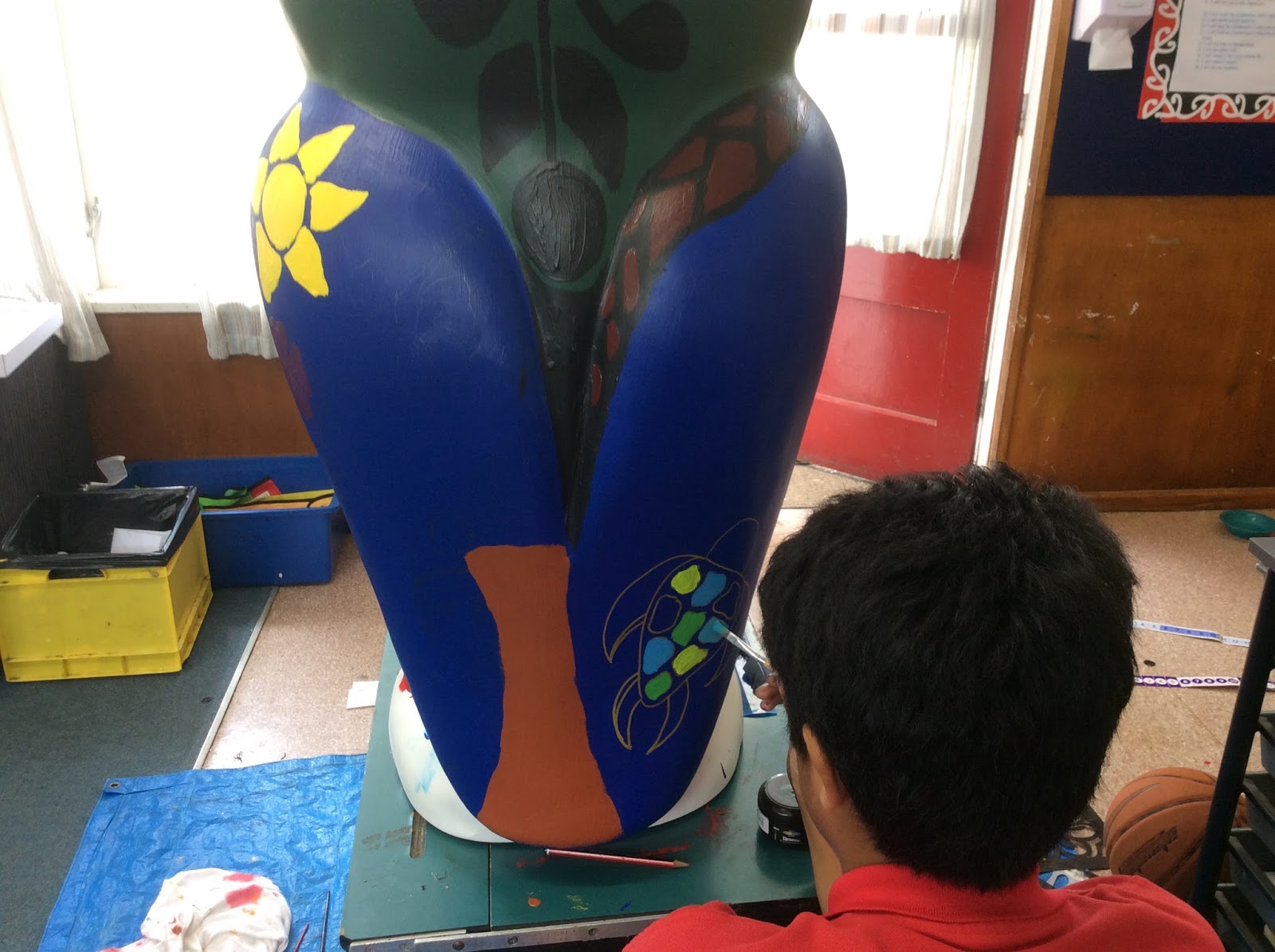
Last year I had the pleasure of working with 4 Year 8 students in the Big Hoot's, Little Hoot fundraiser for Child Cancer. This experience cemented my belief that Art is an amazing way to encourage students to communicate with each other, where they otherwise would not.

To start we gathered together to talk about what this fundraiser meant to them. Cancer had affected each of them differently. Next we discussed what story we wanted our owl to tell. I gave them paper copies of the Owl so they could start designing what they wanted to paint on the Owl. They all had to make compromises and listen to each others ideas. There was the obvious joking around however they knew the enormity of the Charity we were supporting and I was really impressed with how mature they all became pretty quickly. I could see they were taking this project seriously. They wanted our Owl to tell a story of the students at Pt England School who are largely made up of Maori and Pacifika backgrounds.

We named our Owl Te Ahorangi which means 'enlightened one'.

The colours were chosen and the base coats began to go down.


The design on the front of Te Ahorangi became a Maori tribal piece of art. Even though all students were working on all parts of the Owl they each had a personal task that they had designed themselves and wanted to paint. As Isaac began to paint the front of the Owl he soon began to have doubts on how he had approached this.


What impressed me with Isaac was that after he had painted the outline of his design he asked the others what they thought. What followed was a deep discussion between all four artists on how he could make it better. Everyone had advise for him and it was done in a positive and caring way.  I could tell he was frustrated but he decided to paint over his design and start again. We bought some slim paint pencils and the process began again.


Chris took on the task of designing the moku which covered Te Ahorangi's head.


David and Danielle took on the task of painting the wings. The wings were bright and bold and full of life which is how they wanted to represent our Pacifika students. Danielle first played around on the white board to decide how she wanted to approach her painting.


Davids creation coming to life.


                                                           Danielle starting her design.


When I looked at the wings once they were finished a sense of enormous pride came over me. I knew from the looks on David and Danielle's faces they were feeling the exact same emotion.


As I am a year 3 teacher these 4 seniors had to paint inside my classroom when the weather was bad, and in doing so had to involve themselves with my students, who had many questions for them. They were patient and took the time to explain what they were doing and why they were doing it.


When they were waiting for paint to dry they took photos and blogged about this incredible journey they were on. They gave up their lunchtimes and arrived on time every day ready to get to work.


 The collaboration between all four students was wonderful to watch. They were not best mates before this experience but I would hope that after working together on this project they have a new found respect for each other. If they had a disagreement over colours, designs etc,  it was talked about calmly and with a great amount of maturity.


 Rangitoto was included to represent our magnificent Maunga standing proudly in our harbour.


This experience has been the highlight of my teaching career. I want to thank Isaac, David, Chris, and Danielle for allowing me to guide them along a path of exploration in Art. Here are the final photos.


This year I was thrilled to find out that Te Ahorangi was one of 3 Owls entered by 40 schools to be displayed in the city. I went with Danielle to the Auckland City Library to take a photo.


So in conclusion, art is all around us. In it's many forms it represents fantastic opportunities for discussion, focussed language work and skills based activities. It represents the Key Competencies which to me, is the base of all learning. Art breaks down boundaries of social status, religion and cultures. It gives students a voice where they may struggle otherwise. Art is individual beauty and  expression for everyone.


Monday, 29 January 2018

2018 Here We Come!

As a lover of art I went to see the Banksy art exhibition in Auckland. It was amazing and I got so many new and inspiring ideas to take back into my classroom. But one of them really stood out. It's one that any student of any age can understand and I am going to make it one of my great quotes this year.

Sunday, 8 October 2017

Art Creates Equality

Over the holidays I have been putting my students art on their blogs for them. As I was doing this it dawned on me that the art I was looking at was so special and different for every student. I also recognised there was no right or wrong in their art. How can you judge a child's art? What makes one painting better than the other?

The art below is inspired by either sunrise or sunset on the ocean. The children used crayon and dye to create their paintings.We looked at many designs and I modelled a few for the children. The first is from a student who is sitting well above in all curriculum areas.


The next is from a student who is struggling in all academic areas....apart from art!


The next is from a student who is right where they should be according to National Standards. 


When I look at these paintings there is no top, middle and bottom. There is just beauty. This is why I firmly believe that artistic expression is so important for students. It lays the very foundation of creativity, to allow children to think outside the proverbial box.

If children have practice thinking creatively now, it will come naturally to them in their future careers. For young children drawing, painting or sculpting in class helps develop visual-spatial skills. I have seen it bring out perseverance in some students who were challenged and frustrated but I would not let them give up. Funnily enough I noticed the students who find the core curriculum subjects the easiest, were the ones who got the most frustrated. These students had their confidence tested, whilst the students who struggle daily with Reading or Writing managed to cope more calmly with the art assignment. I loved seeing their confidence shine through. The smiles on their faces. The look of pure joy when it came time to share their art and talk about it.

I understand that the art my Year 3 students are doing is modelled by myself first, so there are similarities that cannot be ignored. However, every student always manages to bring their own uniqueness to their work. Watching my students focus, some with tongues slipping out of their mouths, made me smile. To be able to focus is vital for learning in class as well as doing a job later in life.

As we do art in class I often play classical music. At first I got laughter and giggles from my students, as they tend to like rap and hip hop. But after awhile the music took over and a sense of calmness would wash over the classroom. I would explain that the music they are listening to is art in their ears. This would bring many laughs, but one day I hope my students look back with fondness on their time spent in my classroom and remember all the artistic expression I tried to introduce to them.

Sunday, 1 October 2017

Art Incorporating Math

For the last week of school I wanted to do an intense push on art. Recently my class had explored creating art with pastels and crayons and dyes. I wanted to give them a chance to have a choice of the next medium we used.

So first thing in the morning we sat down and talked about what materials they had enjoyed using. Everyone liked the look of the pastels but all agreed they were very messy and were easily smudged. Crayon and dye was a favourite, but it became clear they all wanted to get the paints out.

They separated into groups to talk about what they would like to paint. It became clear that they needed guidance. The last time I let them have free choice completely with what they painted, they all drew these tiny figures with their pencil and then were unable to paint such small details. I had sat back and watched to see who would figure out they needed to draw bigger more simplified designs, maybe 3 children grasped the concept and changed their painting.  The rest of them were disappointed with their end result, opting to throw them in the rubbish bin instead of taking them home.

As we were looking at images on google, I reminded them that sometimes the simple images can be the most effective. We came across some simple black and white paintings children had done. Everyone liked them, so we had our plan.

Each student got a choice of a design and I printed out one A4 size for each. To make sure they got the size in proportion with their paper I decided to incorporate some Math. We got a ruler and a pencil and divided out paper into quarters.


This bought up aspects of math. First they had to correctly use the ruler to find the half way points across the page and down the page. This bought up conversation surrounding halves, doubles and quarters. It was great to see the students who are working in Stage 4 and Early Stage 5 helping out the other students. They then used the same strategy to divide their size A3 paper into quarters.

Using their pencils they had to use the space in each quarter to draw the image they had chosen. Of course there was the usual,,,,"I can't do this" "This is too hard" Some students rubbed out their drawing 3 or 4 times before they understood the concept of spatial awareness. Using words like on, off, under, over, up, down.

Having the paper cut into quarters allowed them to have a realistic view of how big their image had to be and to get the proportions right.

This art project took a few hours from start to finish. I think the best part was seeing the pride on their faces looking at the end result. I have to admit I did join each student towards the end and show them how to tidy up the outlines using a small brush.  The art was simple and best of all it was achievable to every student.


Sunday, 24 September 2017

Maori Legends - Animations . Recounts

Just think of the smiles on your kids’ faces when you read them a great story, or how their eyes light up when you show them tiny plants buds just peeking through the soil.  The great thing about teaching young children is that they have an innate desire to know more about the world.  Sadly, this innate love of learning is often squelched by the time kids hit elementary school, crushed by ineffective academic standards and incorrectly implied curriculum that take the delight out of learning.
But it doesn’t have to be this way!   As a teacher, you can make a big impact on your students’ future love of learning by simply allowing them to learn in a way that’s not only educational but also fun.
As I continue to inquire into how art helps help my students learn, I am becoming increasingly optimistic that there is a link between learning and art. 
Last week I had my students create a piece of Maori art to celebrate Maori Language week. Their art was inspired by NZ's native bush. This was done to inspire their writing. I set the children up to write their Maori legend by first reading them many Maori myths and legends prior to doing their art. I also set up links on their i-pads where they could go and listen to short Maori legends. Some were in English however some were also in Maori. This did not bother the children, they were silent as they all sat on their i-pads with their headphones on listening intently.
My goal was for them
-  to create a cool Maori legend themselves with a message behind it.
- animate their story on their i-pads
- write a recount on the whole process
The children were excited and ready to go. I felt I had set them up properly with all the tools needed. Needless to say I was so proud of each and every student. Even my children who have difficulty with writing were eager to get going.


I have taken the work from their blog so the story's are just how they blogged them errors and all.
The work below is from one of students who excels in writing. She is also reading above the National Standard at Level 30

Mere and the Pukeko
Once upon a time there was a Maori girl called mere and she lived behind a secret beautiful bush.
In their bush it was full of Kowhai's with beautiful yellow flowers and big rata's. one lovely afternoon when mere was fast asleep, a pukeko flew down and the pukeko saw a beautiful shiny necklace and grabbed it and flew away. Then Mere woke up and got upset because it belonged to her great grandmother, so mere goes to God of the sky Ranginui to ask for help.

Mere explained to Ranginui the promblem so Ranginui called out "pukeko please give the necklace back to mere how would you feel if someone stole something of yours" pukeko felt bad so the next night pukeko sneeked and slowly put it back, The next morning Mere found the neacklace she was so glad.

Finally mere and her family celebrated with a beautiful big yummy feast and said a karakia to Ranginui for helping them.


Recount

Last week at school room 15 designed Maori art around flora and flora.

First I got my sharp pencil and drew my design. Secondly I got some greens browns and black pastels and coloured in my drawings. Lastly I got a big piece of black paper and stuck my art on the paper and got some shiny green glitter and decorated my art.

Next I wrote a Maori legend about mere and a pukeko. Finally I went on google and searched for some native NZ bush scenes next I drew my characters and animated my story.


Recount
Last week at school room 15 designed Maori art around the native bush.

First we got a pencil and we design our beautiful Maori art. Secondly we chosed dark and light green - brown- blue pastels and colour in our drawing. Lastly we stuck our outstanding Maori art on the black pieces of paper and we put green glitter on our art. 

Next I wrote my own Maori legend and it was about Pania and the Taniwha. Finally I went online and down load some native NZ bush pictures and I drew my characters and animated my story.


Recount
Last week at school room 15 made Maori art around the native nz bush.

First I got pencil and draw my debasisgn.

Secohdiy I got some green brown and blue pastels and coloured in my designed.

Lastly i got some black paper and stuck my art on.

Next I wrote a Maori legend and then I animated.


The last example is from a student who is reading at level 22. He can write independently.

Maui and Kiwi
Once upon a time there lived a cool boy called Maui and his friend kiwi. They lived in a nz Bausch with yellow flowers and red flowers and it was so beautiful.

One  beautiful day Maui and his kiwi got up and jamped into their amazing waka.they set off to their fishing to their secret Island.

First Maui said to his kiwi run"for your life" Then Maui got his hook  and killed the Taniwha.

Finally Maui and  kiwi got in their waka and went fishing. Then they they got home and ate the fish with they family and told them all about their adventure with the Taniwha.


Recount
Last week at school Room15 designed cool Maori art around the native NZ bush.

First we got a pencil and designed my beautiful colours and it was green brown and blue and coloured my art in and ms Eaid gave us a black paper and and stuck my picture on After that I decorated my art with green glitter.

 Next I wrote a Maori Lagend about Maui and kiwi and I went on google to get my back gound and I drew my characters then I animated my story.